
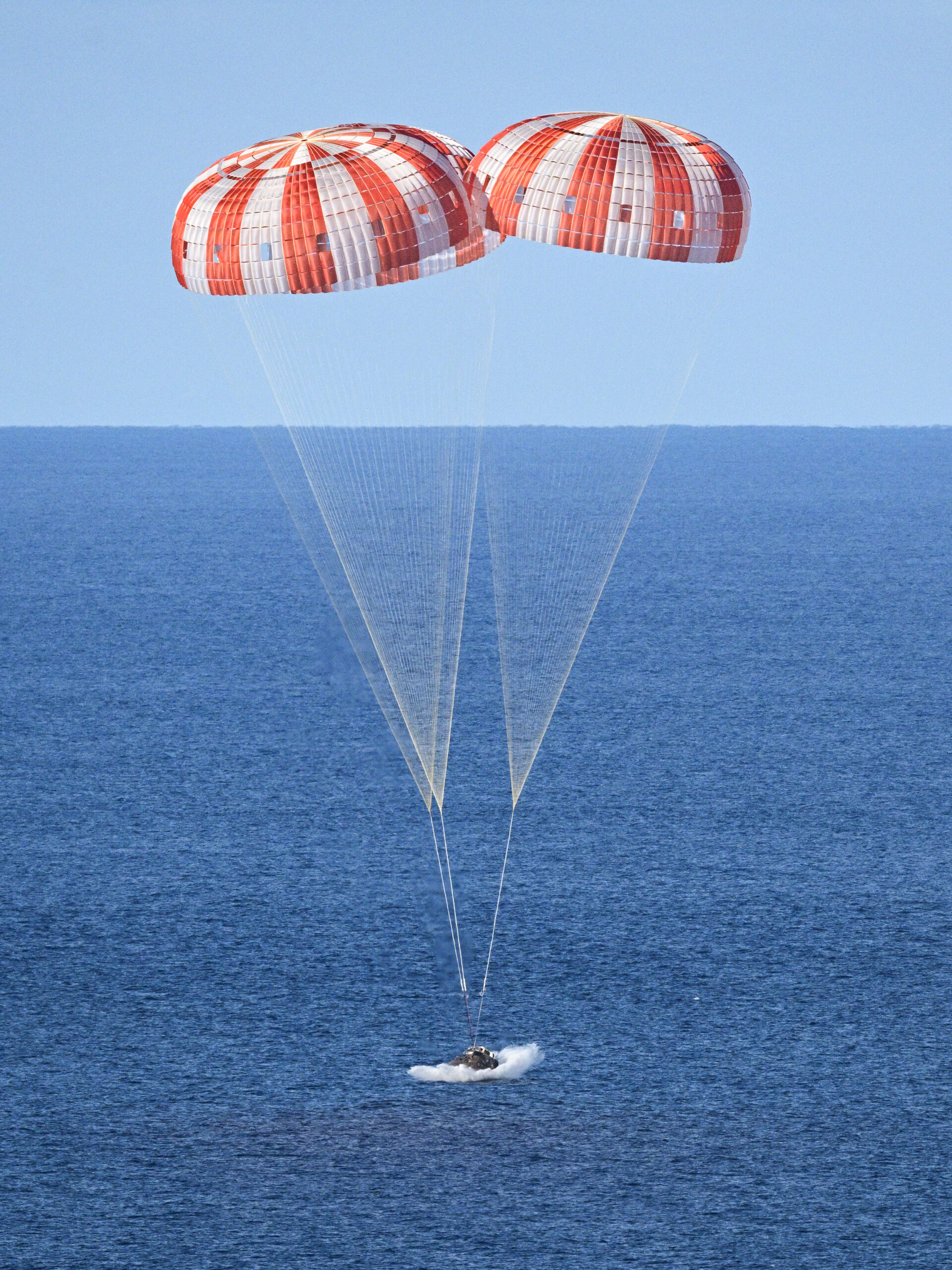
The astronauts of the Artemis II moon mission returned safely to Earth on April 10, after a 10-day trip around the moon. The capsule carrying the astronauts splashed down in the Pacific Ocean right on schedule. A U.S. navy ship and helicopters were waiting to pick up the crew and bring them home.
The Artemis II mission was the first time humans have flown to the moon since 1972. The astronauts didn’t land on the moon, but they circled around it and travelled further from Earth than any other humans have travelled.
The Orion spacecraft was launched from the Kennedy Space Center in Florida on April 1. The crew was made up of mission commander Reid Wiseman, pilot Victor Glover and mission specialist Christina Koch—all from NASA—and mission specialist Jeremy Hansen of the Canadian Space Agency (CSA). Hansen is the first Canadian to travel to the moon.
After launching, the spacecraft orbited the Earth twice so the crew could test the ship’s systems. On the fourth day of their mission, the astronauts left Earth’s orbit and began their journey toward the moon.
The spacecraft followed a “figure 8” flight path which looped behind the moon so the astronauts could observe the far side. (This is sometimes referred to as the “dark side” of the moon because it faces away from Earth, but it is not actually dark all the time.)
On April 6, the crew spent about seven hours passing over the far side of the moon. This time period was called the “lunar flyby.” They used that time to make observations about moon’s surface, and to take photos.
During the flyby, the astronauts set a record for the farthest distance humans have flown from the Earth: 406,771 kilometres. (That’s about a thousand times further away than the International Space Station, which orbits at about 400 kilometres above the Earth.)
They also experienced a solar eclipse, when the sun was directly behind the Moon from the crew’s perspective for about an hour. When the moon was dark, the crew saw several flashes as meteors hit the moon’s surface.
The Artemis II astronauts are not the first humans to see the far side of the moon. In the 1960s and 1970s, astronauts on several Apollo missions orbited the moon. Several uncrewed spacecraft have photographed the far side of the moon, and some have landed on it.
But the Artemis astronauts are the first humans to observe the moon’s far side when it was partially lit up by the sun. This made it possible for them to see and photograph the moon’s surface—including impact craters, elevations, surface fractures and ancient lava flows—in greater detail. This information will help scientists learn more about the geology of the moon.
The crew began their journey back to Earth on April 7.
The mission followed what is called a free-return trajectory. That means it used the pull of gravity from the moon to draw it around to the far side of the moon. When the flyby was complete, it used the Earth’s gravity to pull the spacecraft away from the moon again and guide it back to Earth.
As the spacecraft approached Earth’s atmosphere, it was travelling at about 40,000 kilometres per hour (kph). That’s 40 times faster than a passenger airplane. When it entered the atmosphere, the angle and shape of the spacecraft helped to slow it down. Then a series of 11 parachutes were opened in stages to slow it even further, so it was travelling at about 27 kilometres per hour when it landed in the ocean.
The spacecraft was also covered with heat shields—special material to protect it from the extremely high temperatures outside the capsule as it entered Earth’s atmosphere.
The Artemis II mission was the first time people have flown on an Orion spacecraft. The information scientists will learn from the mission will help them plan future missions to the moon, and possibly one day help humans travel to Mars.
FUN FACTS ABOUT THE MISSION
The crew members of the Artemis II mission were travelling in an Orion spacecraft which they named Integrity. The crew capsule of the Integrity—where they lived during the mission—has about as much space as two minivans.
The astronauts trained in a model of the capsule before the mission to get used to working and moving around in such a small space. But sometimes unexpected things can happen.
The special toilet on the Integrity broke down twice in the early days of the mission. Once, they discovered that some urine had frozen in the vent line. The capsule was rotated so the ice could be warmed by the sun, and the line could be unclogged. While the toilet was broken, the crew had to use bags to collect urine instead.
Then, during a livestream from the capsule just before the astronauts reached the record for the farthest distance travelled by humans in space, a jar of Nutella could be seen floating through the capsule in zero gravity. Some people watching thought it was an advertisement for the spread, but it was just an accident. (Later, Canadian Prime Minister Mark Carney talked to the crew members while they were in space to humorously clarify that they prefer maple syrup, over Nutella, on their pancakes.)
The spacecraft carried about 189 different food items, including dehydrated (dried) meals that are rehydrated and reheated in a special food warmer, and a variety of sweets, like pudding, chocolate and cookies.
In addition to setting a record for distance, the mission had several other “firsts.” Victor Glover is the first black astronaut to go to the moon, Christina Koch is the first woman to travel so far in space, and Jeremy Hansen is the first Canadian. Reid Wiseman, who is 50, is the oldest person to travel to the moon.
Related videos:
The Flight Path of Artemis II, a 30-second video by NASA: https://svs.gsfc.nasa.gov/20412#media_group_379501
Moon Rise Mascot and Zero-Gravity Indicator (2:08)–the story behind “Rise,” the stuffie you may have seen floating around the astronauts during their mission: https://www.youtube.com/watch?v=QquPhtSOxas
How to Eat in Space (4:28) NASA-produced video in which two Artemis II crew members (and members of the NASA team) show some of the foods they ate in space, and how they did it: https://www.youtube.com/watch?v=3Tkib8zc-Ws
Artemis II Geology Training in Iceland (3:13): https://www.youtube.com/watch?v=7LH0AohMW4k
Related websites:
NASA’s Space Place for Kids, a NASA website featuring kid-friendly facts, games, crafts, videos and activities: https://spaceplace.nasa.gov/
Canadian Space Agency (CSA): https://www.asc-csa.gc.ca/eng/
NASA: https://www.nasa.gov/
Photos by NASA of the Artemis II crew and mission, which can be used copyright-free for informational and educational purposes without permission. (You should always credit photos when possible.): https://www.nasa.gov/artemis-ii-multimedia/#images